In the preceding three essays, I mapped the taxonomy of cross-domain learners, dissected a metabolic problem through an integrative lens, and traced how private belief and social structure lock each other in a reflexive loop. A question has been hovering since Part I: by what right do I claim to be an Integrator rather than a Scanner? By what evidence do I argue that this is not merely another episode of unfocused dabbling?
The answer is simple: I have taken every wrong turn, and I am still walking.
This final essay is a decade's worth of field notes from the path itself.
I. From Hoarding to Generation: The Architecture of Cross-Domain Knowledge
Zotero and Obsidian: A Digital Workflow
Since 2021, I have fed every digital text I encounter into a single Zotero library. The collection now holds more than eight hundred items—books and journal articles in roughly equal measure. That averages to perhaps forty books a year, a modest tally compared to those who claim to read dozens in a month. The library is organised by national disciplinary codes, from natural sciences to social sciences and the humanities, with stray volumes on agronomy (grain and health), food technology (coffee processing), and archival science (classification systems) shelved at the margins—tactile points of tangential contact.
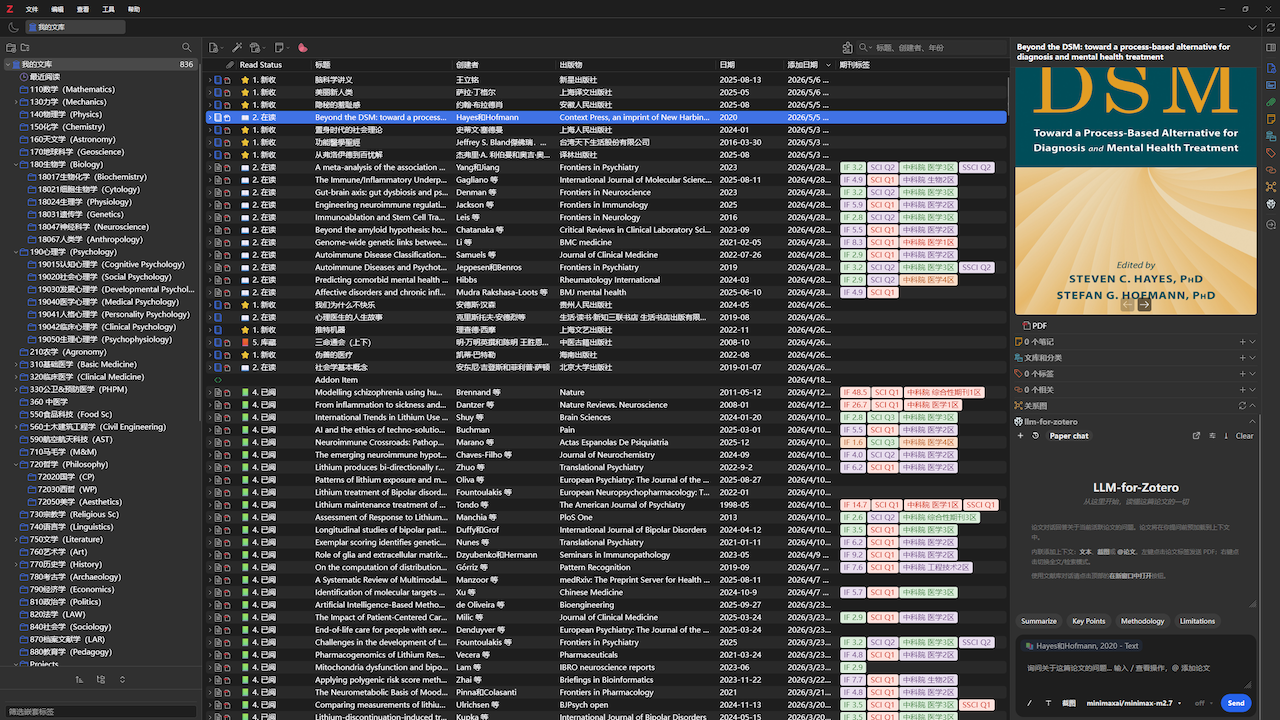
These texts do not become digital hoarding, and this explains why my reading is slow. Any book worth reading demands a second investment of time in note-taking. I follow the method attributed to Zhongshu Qian (an Oxford scholar and one of China's most celebrated modern writers): he reputedly spent as long on his reading notes as on the reading itself, doubling the temporal cost. In my own practice, I read with a pen, capturing fleeting notes; once finished, I return to reconcile convergent and contradictory arguments into deeper literature notes. Much context must be re-read and re-understood, yet this very labour filters out what does not deserve to be preserved.
Obsidian serves as my second brain. It houses all notes, permanent cards, and drafts in a single Knowledge Management System (KMS), separate from diaries and creative work stored in other vaults. The graphic view of the KMS is a riot of colour—red for philosophy, yellow for sociology, blue for biology, purple for psychology—each discipline a distinct territory, with threads of connection running between them. This is the most immediate visual evidence of cross-domain linkage.
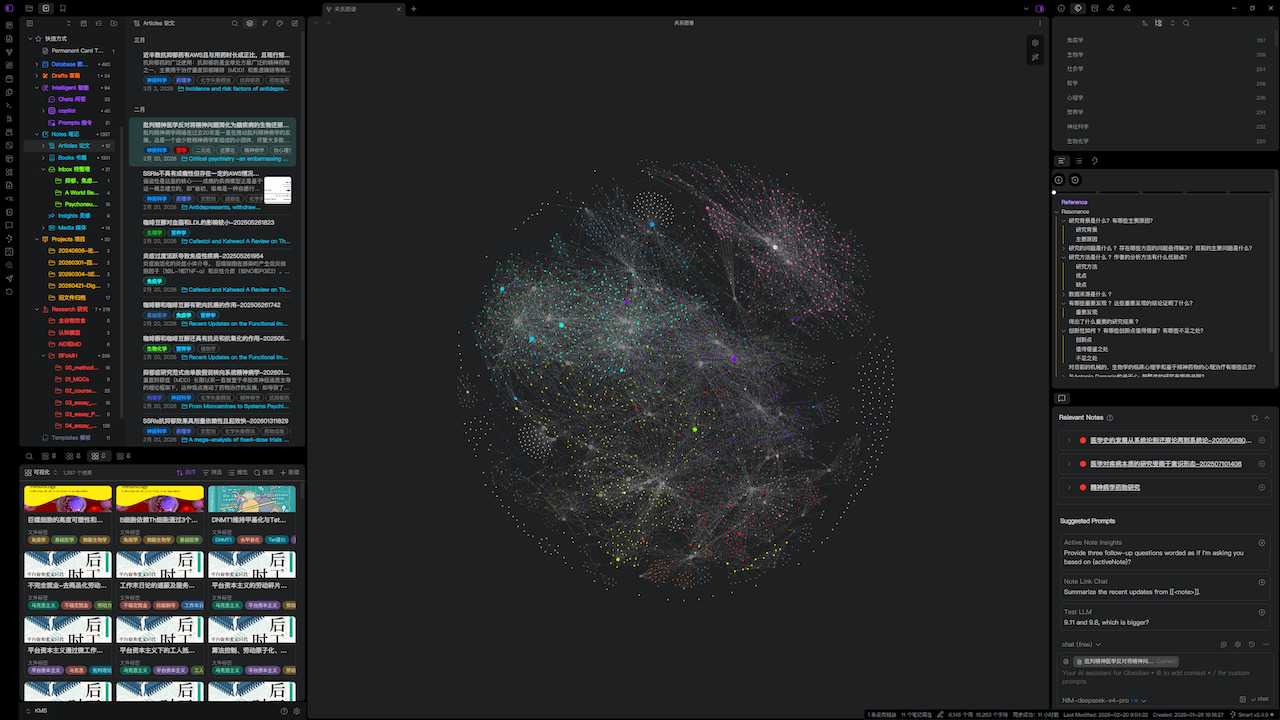
The workflow is therefore complete: Zotero for capture and reading, Obsidian for notation, card-writing, drafting, and inter-domain linking. Cross-domain learning and integration are enacted through this architecture.
The Best Record Is Not Neat Prose, but Scribbles and Sketches
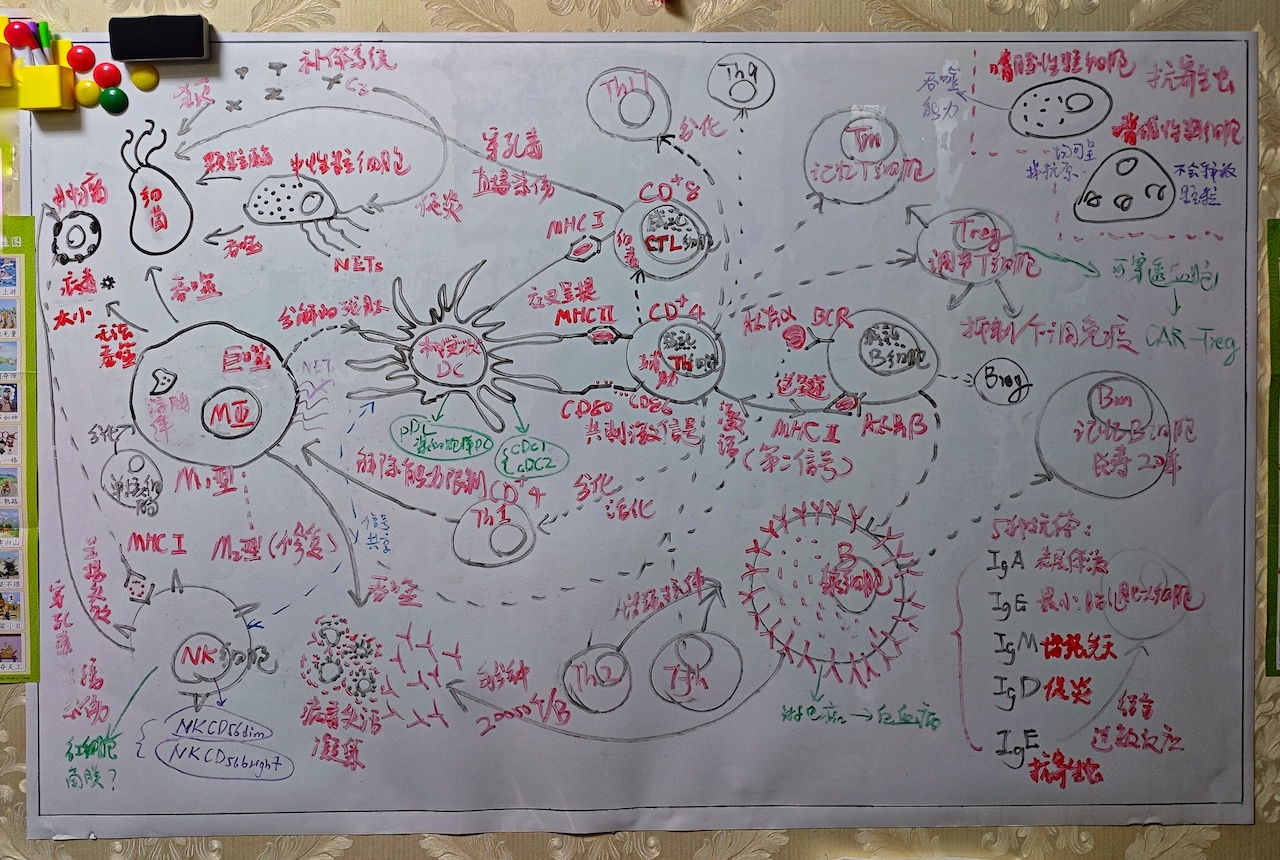
Last year, having begun immunology from scratch, I waded through several massive textbooks in both Chinese and English. The material was cacophonous: innumerable immune cells, inflammasomes, complement cascades, all colliding in working memory. The noise did not subside until I stood before a whiteboard and, from memory, drew the fundamental mechanism of immune response. The world went quiet. I understood then that writing and drawing had imposed order on chaotic associations; the noise was gone because the knowledge had been internalised. I could erase the board, discard the notes, and the structure would remain.
Neuroscience presented another formidable challenge. To buy myself time before the term began, I devoured a thousand-page textbook during the winter break. A physical brain model was prohibitively expensive; to comprehend the complex three-dimensional architecture, I drew and coloured my own, taped it to the window, and annotated it with acrylic pens. This daily act of looking up at a hand-drawn brain did not grant mastery over the three-pound universe, but it reduced the friction enormously by the time lectures commenced.
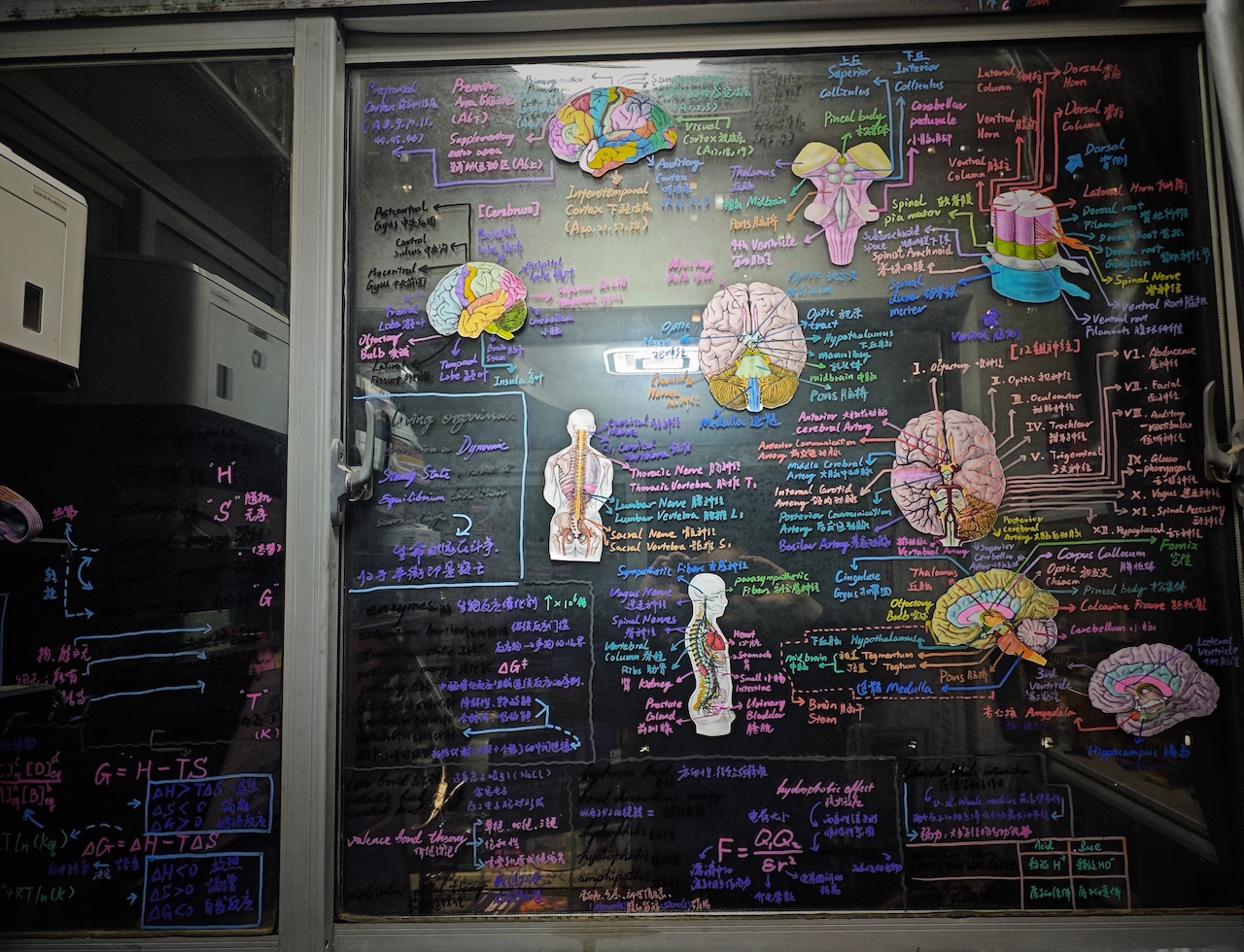
Painting, topology, neuroscience, and anatomy can therefore be integrated. Drawing is, after all, a human instinct; sketching by hand is a form of cognitive manual labour. It forces knowledge from the retina through the occipital lobe, encodes it via the motor cortex, and completes its conceptual solidification in the prefrontal cortex. To borrow the taxonomy from Part I: when the Scanner watches a lecture at 1.5× speed and believes they have learned, the Integrator draws a crude diagram at 0.5× speed and knows they have not.
II. The Instrumental Rationality Trap: When Tools Become Excuses
Methodology Is Not the Destination
The literature on Zettelkasten, the Feynman Technique, and their digital descendants is already abundant, and I shall not add to the noise. But I must issue a warning: beware the instrumental rationality trap.
When one treats a card-based note system as an instant solution to the problem of writing, the short-term result is not immediate relief but a cycle of tinkering, frustration, iteration, and meta-analysis. I remember the years when digital tools proliferated—Notion, DevonThink, Obsidian—each promising the perfect system. My energy was consumed migrating notes, designing taxonomies, and debugging plugins. The knowledge network was never built; I had become a product reviewer of note-taking software. This is the predicament that every long-term learner eventually faces: the busyness afforded by instrumental rationality masks a deeper laziness in the labour of self-cognition.
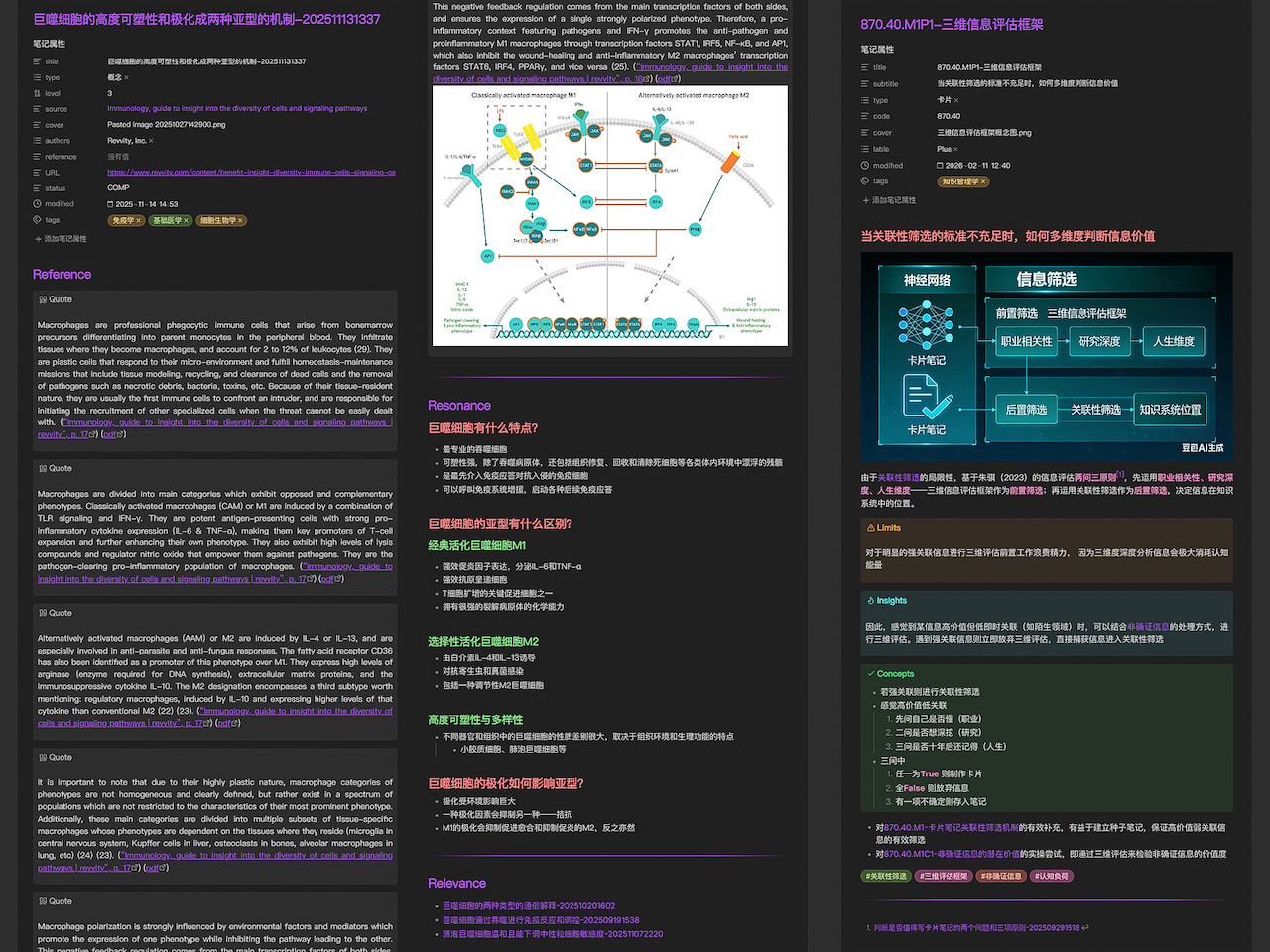
The cross-domain learner is especially vulnerable to this error. When searching for a better tool becomes a prerequisite for learning, when one arranges bookshelves to avoid writing and debugs plugins to avoid thinking, one regresses from Integrator to Arbitrager—only the arbitraged commodity is the illusion of efficiency.
The Arbitrager of Part I hunts for instrumental returns across domains. The tool-obsessed learner hunts for instrumental returns across software. Both withdraw the moment marginal returns diminish. The only difference is that one chases money; the other chases the dopamine of a perfectly configured system.
A Caution Against Cognitive Outsourcing in the Age of AI
Does the long-term stability of the Zotero-Obsidian workflow mean the wrong turns are finally behind me? Not at all. Recently, influenced by the llm-wiki movement, I found myself rebuilding the KMS around Hermes Agent, attempting to automate the entire knowledge base. The existing manual system was not broken; the promise of AI automation was simply too seductive. Weeks were lost to debugging, coding, and troubleshooting.
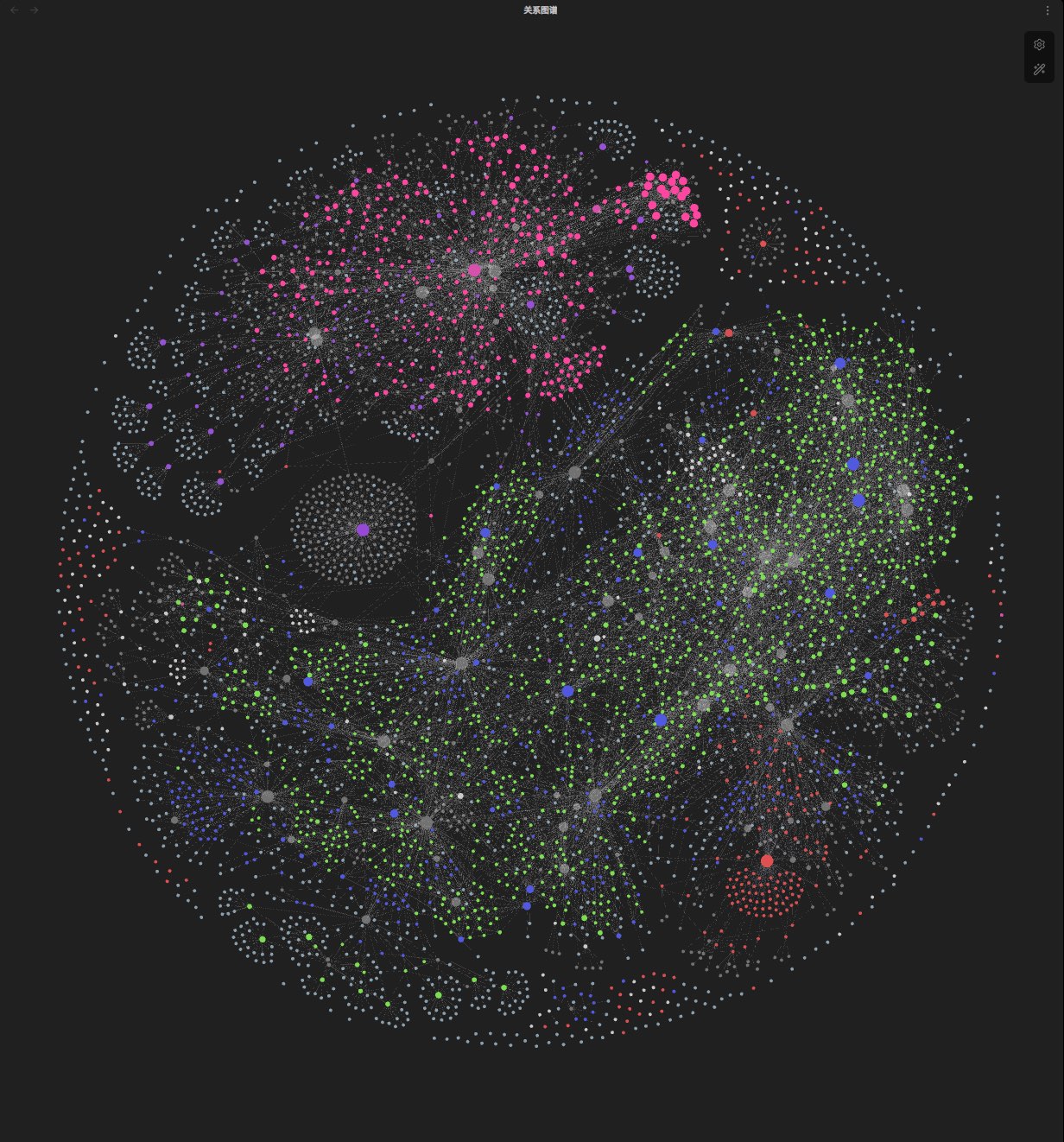
In the past month, the algorithm has generated hundreds of linked notes. They appear in the graph view in magenta, while the notes and cards I have built by hand over years remain in green and blue. I cannot yet render a verdict; I must let the experiment run. For now, the two territories are strictly quarantined. I do not know whether the moment I open the border to AI will see human cognition drowned in a magenta tide, or whether the algorithm will ultimately be domesticated by human will. What I do know is this: when AI can read your literature, write your notes, forge your connections, and even draft your papers, the human who outsources their thinking to the machine is degenerating into something less than human. If notes do not compel thinking, recording is meaningless; and if writing does not compel thinking—writing is thinking.
III. The Necessary Courage and the Inevitable Solitude
The Courage to Return to Rigorous Scholarship
One of the deepest motives for returning to formal study in psychology and neuroscience at KCL was to subject the Zettelkasten method and years of cross-domain practice to a stress test. Luhmann reportedly published more than seventy monographs and four hundred articles. Could I, at the very least, produce work of greater value than what I managed twenty years ago?
The diagram below is a stitched screenshot of the Map of Content (MOC) for a recent term paper in my Obsidian vault.
Receive prompt → Set aside → Deadline approaches → Scramble for sources → Hastily assemble → Submit
Place prompt and target literature into KMS for vector association
↓ Locate the conceptual neighbourhood
↓ Discover cross-domain connections in the graph
↓ Construct MOC; fill gaps iteratively
↓ Assemble existing permanent cards with new notes
↳ Essay and MOC co-evolve until form emerges
Writing does not begin with the first word; it begins with the first connection between ideas, and from there it grows with a momentum of its own. The final headache is usually exceeding the word limit. Yet even then, one must kneel before the academic evaluation system. When my last essay spanned electrophysiology and neuroimmunology, integrating sociology and medical ethics, the examiner praised my argumentation and evidence yet awarded a modest mark. The reason given: this was merely a term paper, and I was not to write it with the ambition of a SCI submission.
Beyond the trial of academic writing, I returned to the academy because I did not wish to be dismissed as a crank—the stereotype of the half-educated dabbler who floats between rigour and wild speculation. Through disciplined training, one at least learns the language of the guild, enabling one to critique their parochialism in their own terms. Without understanding, there can be no judgment; without investigation, there is no right to speak. Moreover, AI is reshaping the paradigm of learning. Those scholars who oppose AI are, in essence, terrified that their moat is being filled and their walls pulled down. For the cross-domain learner, this is auspicious: we carry no heavy historical baggage, and can embrace the new paradigm without mourning the old.
This, finally, is the true meaning of education. As Robert Pirsig imagined:
The student's biggest problem is the intellectual laziness produced by years of carrots and sticks. Like a donkey... the student will leave school without hurting anyone... because he never came for genuine knowledge in the first place... He may find a job and settle into being a low-grade donkey—say, a mechanic... His creative instinct, suppressed by school theories and grades, may now be awakened by the boredom of his work... And so he will return to a school without grades or degrees, but this time he will be different. He will no longer come for grades; he will come for the pursuit of genuine knowledge. —— Zen and the Art of Motorcycle Maintenance
Holding One's Coordinates Amid Social and Domestic Tension
The future of the cross-domain learner has never been clear. The obscurity and difficulty come from society and from family. Structurally, the cross-domain learner occupies the high-competence, low-warmth quadrant of social perception: they cannot be classified by a single label, which triggers cognitive dissonance and hostility. When confronting an elder, a surface disagreement over ideas can provoke a deeper narcissistic threat to their identity as a credentialed intellectual—especially for those certified by the institutions of the last century. The cross-domain learner is, by nature, a challenge to the monopoly of professional authority and to the hierarchical assumption that only orthodox training confers the right to speak.
Even within the family, this tension is not absent. Yet most cross-domain learners are fortunate: their parents may worry at first, but they eventually accommodate, and finally support. And none of this would be possible without the understanding and quiet sacrifice of a husband or wife.
III. Conclusion: There Is No Destination, and No Standard Answer
For all my planning, none of this unfolded according to plan. As I said at the outset, the path of the cross-domain learner is strewn with thorns and detours, but also with unexpected grace.
In 2016, I stumbled upon Markdown while looking for an efficient way to typeset travel photography essays. A decade later, as AI became mainstream, that skill—ridiculed by friends as useless—allowed me to write prompts and skills with zero friction. It is the calligraphy course Steve Jobs described in his Stanford address: you cannot connect the dots looking forward, but looking back, every dot is indispensable. This was the first accidental cross-domain sowing.
In 2019, having matured as a post-processing photographer, I fell into aesthetic fatigue. When every visual effect could be achieved in Photoshop, I discovered how shallow my pursuit of beauty had been. A photograph that delivered a few seconds of sensory stimulation left only hollowness. I began to ask: what is the meaning behind the image? The emptiness of photography and the superficiality of creation pushed me toward the philosophy of art, and from there, systematically into the history of philosophy—from the pre-Socratics to the Eastern traditions.
In 2020, my daughter was born. Faced with professional uncertainty and an ever-growing archive of notes, I began to search systematically for a knowledge management system: from paper journals to Evernote, and finally to Luhmann's Zettelkasten. I realised then that notes are not for preservation; they are for generation—for generating ideas, connections, and thought. The excitement was sudden and overwhelming; I had found what I had been seeking. At the time, I was anxious about what I should prepare, and in what form I should hand the most valuable things to her as she grew older. This anxiety turned me inward: what should a father truly leave for his child?
By then, the meaning of cross-domain learning needed no further explanation.
Polymaths, beware: the relentless pursuit of reason can become a purely intellectual game3. And be vigilant—scientism is becoming the new superstition.
We have all come this far, and we must go on.
If you are on this path too, you are welcome to walk alongside.
This essay draws on personal study notes and literature review. It does not constitute medical or academic advice.
References
- Pirsig RM. Zen and the Art of Motorcycle Maintenance: An Inquiry into Values. New York: William Morrow & Company; 1974. [Chinese edition: 罗伯特·M. 波西格. 禅与摩托车维修艺术. 张国辰, 译. 重庆: 重庆出版社; 2011.]
- Ahrens S. How to Take Smart Notes: One Simple Technique to Boost Writing, Learning and Thinking—for Students, Academics and Nonfiction Book Writers. North Charleston: CreateSpace; 2017.
- Revel JF, Ricard M. Le Moine et le Philosophe. Shanghai: East China Normal University Press; 2014. [Chinese edition: 让 - 弗朗索瓦・何维勒,马修・理查德。僧侣与哲学家。赖声川,译。上海:华东师范大学出版社;2014.]