I know the type—because, in many ways, I am one. The person who finds themselves simultaneously drawn to photography, philosophy, sociology, psychology, and neuroscience, yet cannot point to a single conventionally recognised "achievement" in any of them. To society, they are flaky. Lacking follow-through. Dilettantes who refuse to commit.
Over the past five years, I have moved from working as a management consultant and a contract photographer for Visual China Group to pursuing a master's degree in psychology and neuroscience at KCL. That transition has led me to a counter-intuitive conclusion: the problem is rarely that one has "too many interests." More often, the problem is that one has taken the wrong path of differentiation.

In 2018, Emilie Wapnick introduced the term Multipotentialite—a neologism for those with intense creative interests across multiple domains1. The concept gained immediate traction, giving voice to those who resist the modern imperative to specialise and challenging the assumption that a single-track career is the only respectable option.
Yet it left two harder questions unanswered.
1.Does an interest in many domains necessarily imply potential in many domains?
2.Can a Multipotentialite actually achieve success that society will recognise?
The world is full of people who want everything and try everything, burning through enthusiasms without mastering any. Consider an acquaintance from imagination who coasts through office hours slacking off for fiction writing, spends weekends researching fishing techniques, and holds forth on geopolitics. At best, This is a Multi-interest Enthusiast. When Wapnick took the TED stage, she was understandably seeking the broadest possible resonance; in doing so, she made "being interested" her sole criterion, conflating the three-minute enthusiast with the person who genuinely possesses cross-domain potential.
It seemed necessary, then, to build a taxonomy of the "unfocused"—both to locate myself hermeneutically and, ideally, to predict developmental trajectories. Drawing on existing research, I have attempted to expand Wapnick's framework into something more discriminating: a Differentiation Matrix. I should be clear: this is the product of sustained reflection rather than rigorous empirical validation. The full theoretical architecture would require a separate paper. What follows is a sketch.
II. The Matrix: Motivation Meets Cognitive Depth
The central flaw in the Multipotentialite concept is its over-inclusivity. It treats "having interests" as the decisive variable, while neglecting two far more consequential dimensions: the source of motivation2 and the depth of cognitive engagement3. Working from this insight, I have constructed a two-dimensional model. The horizontal axis represents motivational orientation (extrinsic versus intrinsic); the vertical axis represents cognitive depth (shallow exploration versus deep integration). This yields four quadrants:
| Shallow Exploration | Deep Integration | |
|---|---|---|
| Extrinsic, Instrumental Drive | The Free-rider | The Arbitrager |
| Intrinsic, Meaning-driven | The Scanner | The Integrator |
To refine these categories, I borrow an analogy from cell biology. In immunology, a naive CD4+ T cell, depending on the cytokine signals it receives, differentiates into distinct effector lineages—Th1, Th2, Treg, and so on4. I treat the matrix origin as the Naive Multi-interest Enthusiast: just as the naive T cell's fate is determined by its micro-environment, the undifferentiated multi-interest individual is pushed by motivation and cognition toward radically different destinations. The figure below illustrates this:
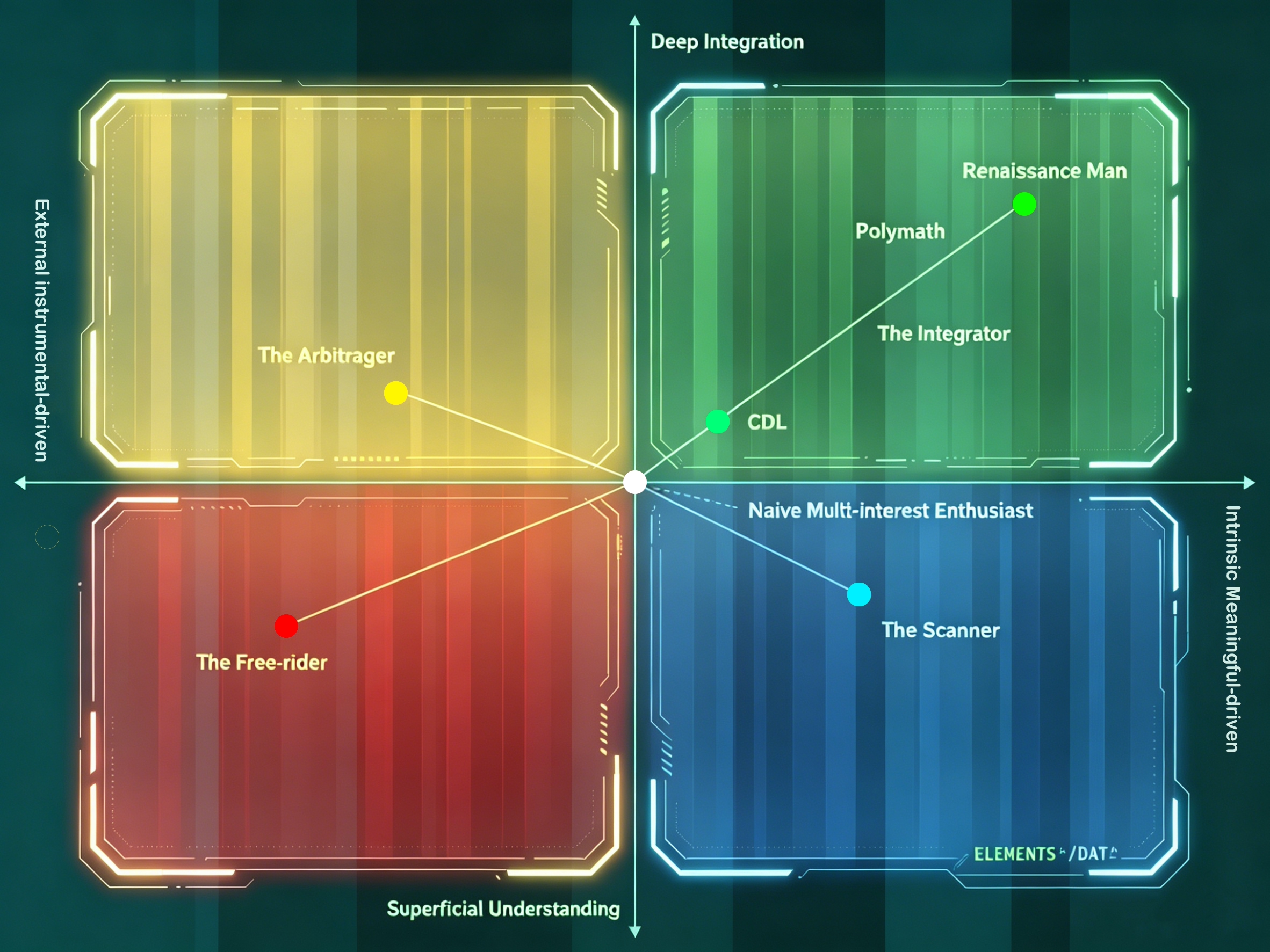
My taxonomy is grounded in autobiography and observation. To those who recognise themselves in these descriptions, I offer my apologies in advance. Let us examine each quadrant in turn.
Drawing on the economic theory of free-riding5, I would argue that most multi-interest individuals fall here. The defining quality is a desire for the harvest without the sowing. They are driven by novelty and stimulation, not by the slow, unglamorous grind of understanding. Because they refuse cognitive labour, they outsource the moment curiosity strikes—first to other people, now, overwhelmingly, to artificial intelligence. They fire off a query, receive a polished answer, and walk away with the illusion of comprehension. Their eyes have seen; their hands have not worked. This is not cross-domain learning. It is cross-domain consumption. It is the degenerative path.
The Arbitrager possesses genuine acuity in spotting extrinsic value. This capacity to perceive the instrumental utility of knowledge keeps their interests broad. Yet because their motivation is externally triggered rather than driven by an inner puzzle, they lack patience for prolonged trial and error. Want to start a business? Study corporate law and finance—better yet, outsource them. Want to build an application? Learn to prompt Claude Code effectively—no need to understand programming itself. Theirs is not cross-domain cultivation; it is cross-domain hunting. The engagement is conditional: the moment the return on investment becomes uncertain and marginal returns diminish, they withdraw. It is a semi-mature path.
The Scanner6—borrowing Barbara Sher's term—rejects knowledge packaged in utilitarian terms and embraces holistic growth. They come closest to Wapnick's idealised Multipotentialite: driven by genuine inner impulse, endlessly curious, yet lacking an integrative framework. In the flood of information, they suffer from chronic FOMO, launching parallel projects, consuming content at 1.5× speed, terrified that somewhere, something important is happening without them. They wake up wanting to learn rocket science, pivot to behavioural psychology by noon, watch flight tutorials in the evening, and fall asleep to a podcast. They are cross-domain tourists, forever checking in at new destinations, forever anxious about the scenery they are missing.
The Integrator is the rarest and, I suspect, the most beleaguered. Few arrive here directly from the origin. Most must first wander through other quadrants, endure false starts, and only then find their way—survivors, in a sense. Like the Scanner, they are intrinsically motivated; unlike the Scanner, they are not satisfied with knowing why something matters. They want to know how it connects. They possess a disciplined filter: they select knowledge based on its potential to form cross-domain bridges. They endure the long cycle of trial, error, and recalibration, allowing the lines of theory and practice to spiral upward in mutual reinforcement. Through this positive feedback loop, they gradually verify connections, reshape existing knowledge, and generate new knowledge. They are not tourists. They are architects. This is the fully mature path.
III. The Cross-domain Learner and the Polymath
The Cross-domain Learner occupies the lower reaches of the Integrator quadrant, stretching diagonally upward from the origin—an early-stage position that has not yet achieved ultimate cognitive synthesis. At the extreme upper-right corner sits the Polymath, or what Renaissance Man7. History remembers those who reach this summit, yet they are vanishingly rare. Most people, even after a lifetime, remain Cross-domain Learners. That is no tragedy—unless one accepts the judgment of meritocracy8, which tends to dismiss such lives as eccentric, impractical, or self-indulgent.

Only a handful gain recognition from a utilitarian society—figures like Charlie Munger, Steve Jobs, and Elon Musk—precisely because their biographies read like histories of boundary-crossing. Yet they remain impossible to replicate, and thus cannot serve as direct models for ordinary lives.
Even those who achieve polymathic distinction are usually remembered by a single professional label. This makes the Cross-domain Learner's struggle for recognition doubly difficult. Consider how the following figures are known to the world by their attributed domain, rather than by the full breadth of their achievement:
| Figure | Visible Identity | Cross-domain Achievements |
|---|---|---|
| Leonardo da Vinci | Painting; the apex of art | Anatomy, mechanical engineering, fluid physics, optics |
| Blaise Pascal | Pascal's law; mechanics | Pascal's triangle (mathematics), political sociology, existentialist philosophy, literature |
| René Descartes | Philosophy; pioneer of the Enlightenment | Analytic geometry, optics, mechanics, moral and political theory |
| Demis Hassabis | Artificial intelligence; DeepMind | Nobel Prize in Chemistry, neuroscience, cognitive psychology, chess grandmaster |
IV. Differentiation as Dynamic Process, Not Destiny
I must stress that, in lived experience, the journey from Naive Multi-interest Enthusiast to Cross-domain Learner is almost never a straight line from the origin. I know this from my own biography: I began as a Scanner, suffered repeated setbacks, and only gradually pivoted across the horizontal axis into Integrator territory. Differentiation is unstable. Any position, at any point in life, may evolve toward the upper right under shifting internal and external pressures—or regress in the opposite direction.
AI's rapid advance fuels this two-way divide. Those opting to lean on machines will gradually outsource their thinking, growing passive amid algorithm-driven ease. By contrast, The Integrators leverage AI to strengthen cross-linking and comprehensive analysis, steadily elevating their personal capability.
One's current positioning in this framework is never fixed destiny; it remains adjustable anytime through intentional mental training and sincere reflection on inner drives.
Where Do You Stand?
For those still unsure where they stand after reading up to this point, three questions can offer guidance:
1.When a new field captures your attention, is your first instinct "I want to understand this" or "I want to use this to solve a specific problem"? The former suggests intrinsic drive; the latter, extrinsic.
2.In the course of learning, do you habitually pause to ask how new knowledge connects to what you already hold? Regular reflection of this kind indicates deep rather than shallow engagement.
3.When an AI delivers a ten-second summary of an entire field, do you feel satisfied and stop, or do you recognise it as merely a starting point? Satisfaction points toward the Free-rider or Scanner; restless curiosity toward the Integrator.
Naturally, such tools remain simplistic. Genuine personal distinction is far more complex than any self-assessment can capture. Even so, they serve as a solid initial reference, revealing that diverse interests pose no real issue. What truly matters is whether one's driving motivation matches their depth of thinking.
This essay draws on personal study notes and literature review. It does not constitute medical or academic advice.
References
- Wapnick E. How to Be Everything: A Guide for Those Who (Still) Don't Know What They Want to Be When They Grow Up. New York: Harper Perennial; 2018.
- Deci EL, Ryan RM. Intrinsic Motivation and Self-Determination in Human Behavior. New York: Plenum; 1985.
- Kidd C, Hayden BY. The psychology and neuroscience of curiosity. Neuron. 2015;88(3):449–460. doi:10.1016/j.neuron.2015.09.010
- Murphy KM, Weaver C, Berg LJ. Janeway's Immunobiology. 10th ed. New York: W. W. Norton & Company; 2022.
- Olson M. The Logic of Collective Action: Public Goods and the Theory of Groups. Cambridge, MA: Harvard University Press; 1965. [Chinese edition: 曼瑟尔·奥尔森. 集体行动的逻辑. 陈郁, 郭宇峰, 李崇新, 译. 上海: 格致出版社; 2017.]
- Sher B. Refuse to Choose! A Revolutionary Program for Doing Everything That You Love. New York: Rodale Books; 2007.
- Burke P. The Polymath and His Times. [Chinese edition: 彼得·柏克. 博学者与他们的时代. 赖盈满, 译. 台北: 麦田出版; 2022.]
- Markovits D. The Meritocracy Trap. [Chinese edition: 丹尼尔·马科维茨. 精英陷阱. 白瑞霞, 译. 北京: 中信出版社; 2024.]